
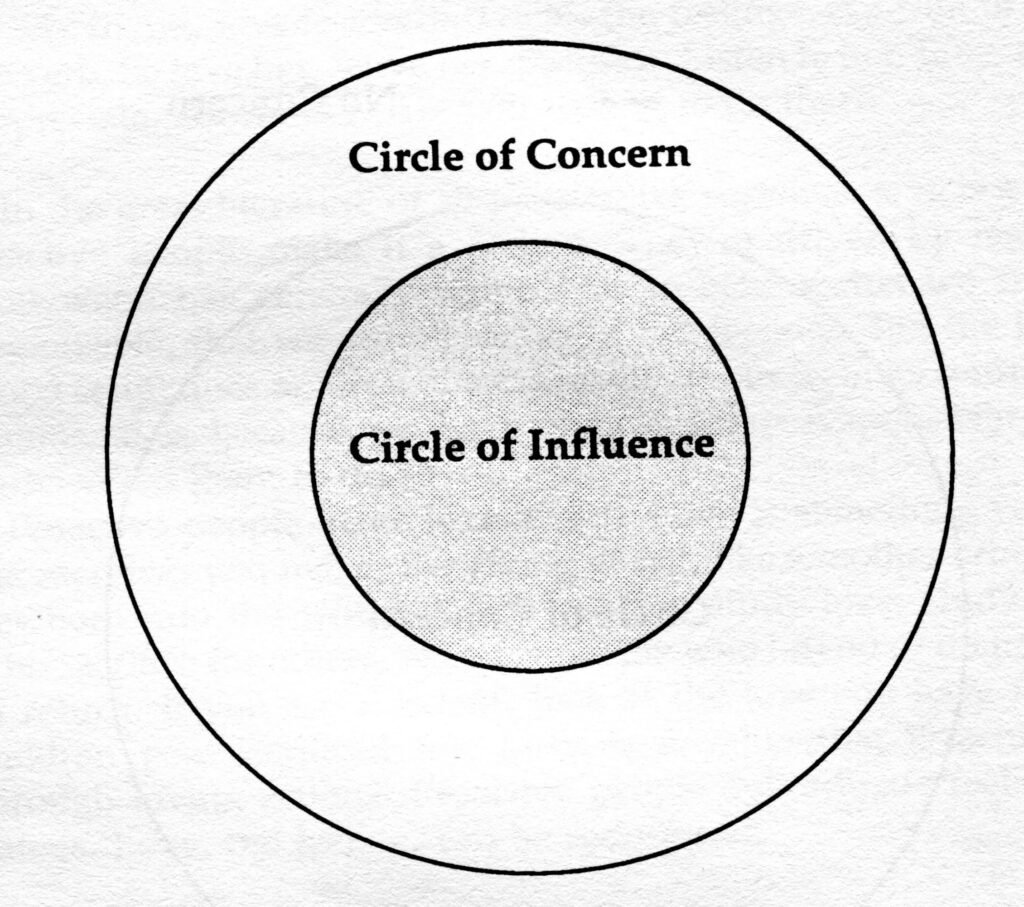
Another full week – this one full of distractions. I’ve found myself needing to tune-out of American politics – it’s not good for my mental health. I’ve been a keen student of US politics for the past 20+ years – simply because where they go, we inevitably seem to follow. I’m reminded, yet again, of the 1st of Steven Covey’s Seven Habits of Highly Effective People (Be Proactive), where he says: ‘Proactive people focus their efforts in the Circle of Influence. They work on the things they can do something about. The nature of their energy is positive, enlarging, and magnifying, causing their Circle of Influence to increase. Reactive people, on the other hand, focus their efforts in the Circle of Concern. They focus on the weaknesses of other people, the problems in the environment, and circumstances over which they have no control. Their focus results in blaming and accusing attitudes, reactive language, and increased feelings of victimisation. The negative energy generated by that focus, combined with neglect in areas they could do something about, causes their circle of influence to shrink.’
I think it’s time to re-read Covey.
Leadership & Personal Development Resources
Your Leadership Style Might Be Helping or Holding Your Team Back
As I look back over the past 36 years of active pastoral ministry, I’m left challenged by the main question raised in this article – what decisions have been primarily motivated by love (that ‘agape’ love which seeks the highest and best good of the other) and which have been, even secretly – disguised in noble sounding rhetoric, actually been driven by fear? The subtitle for the article is: Fear builds rules. Love builds culture. Only one scales. This challenging article can be engaged with here: https://www.inc.com/moshe-engelberg/constraints-vs-trust-how-leadership-affects-team-performance/91333937
Why Resistance to Change Isn’t the Real Problem
This compassionate article invites us to consider the ‘why’ question. While I get the impression that in the counselling/psychotherapeutic community ‘why’ questions are regarded as best avoided, I’m left with the clear perception that answering the ‘why’ question is the surest way to understanding, and ultimately being able to chart a way forward. Resistance to change nearly always involve protection of something, the author of this article suggests, something that is held sacred. To be able to move forward in an honouring way we need to understand what this is. We may discover that honouring this ultimately helps us find a more useful and shared way forward. The article can be engaged with here: https://www.inc.com/jeff-degraff/why-resistance-to-change-isnt-the-real-problem/91337322
Acting with moral clarity
Continuing in the underlying motives theme, it’s easy to assume that as long as we believe that we’re acting for God and God’s kingdom, that the ends we’re seeking to achieve justifies our means. After all, we want what’s best. For God, for the Kingdom, for the ‘unsaved’ community, for the Body of Christ. Yet, just because we believe this to be the case, does it make our all strategizing and manoeuvring to achieve our objectives okay? I’ve long believed that the ends never justify the means, and that how we proceed, our processes, are ultimately no less important than the ends we’re seeking. Behave less than honourably, even in the most worthy of causes, and we’ve poisoned the well from which we will long drink. Unfortunately, since I have my own blind spots, it’s likely that I’ve not always acted with the clarity of purpose that I hope for from others. We all ultimately live with the downstream consequences of our actions. This useful ‘Smartbrief’ article raised a red flag for me, and can be accessed here: https://www.smartbrief.com/original/acting-with-moral-clarity
Homilies and Preaching Resources
My response to the lectionary Gospel for the 17th of May – John 17 vs 1-1, the beginning of Jesus’ high priestly prayer, focusses specifically on vs 3, where Jesus promises eternal life – that which is found in an intimate relationship with the Father and the Son. This gives rise to my title ‘Knowing Eternal Life’. It can be engaged with here: https://www.youtube.com/watch?v=s_eZ9CX6VZE
Gospel Conversations – out of the Dunedin Anglican Diocese. They host a conversation of 4 Theologians / Practitioners. The site with all its options can be accessed here: https://www.calledsouth.org.nz/gospel-conversations/. Led by Michael Godfrey, rather than the Gospel text, they are focusing on other parts of the Lectionary. For this coming Sunday the 17th of May, they’re focussing on the Sunday after Ascension, leading up to Pentecost, considering Acts 1:6-18. It can be accessed here: https://www.youtube.com/watch?v=6OoMVIfhhzQ
Rev Darryn Hickling (Methodist colleague leading the Rolleston Project) has posted a brief reflection on Instagram – focussing on John 17 vs 1-11, and titled ‘What Fullness of Life Looks Like’. It can be accessed here: https://www.instagram.com/reel/DYMLu3Iha1i/?igsh=MXR0MmNqc2ZkczJpcA==